



Why study Chemistry at ANU?
Chemistry at ANU gives you the opportunity to tackle some of society’s biggest challenges — developing the skills to understand, analyse, create and solve problems that don’t yet have known solutions.
As a research-intensive discipline, Chemistry at ANU combines fundamental, world-class science with state-of-the-art techniques spanning multiple scales — from molecules to advanced materials — inside a collaborative and highly personal learning environment. Students learn alongside internationally recognised researchers, with opportunities to become embedded in research early on.
Three research areas
- Materials Chemistry — chemistry spanning molecules to advanced materials.
- Biological Chemistry — molecular chemistry applied to biology and human health.
- Synthetic Chemistry — new synthetic methods and functional molecules, built from first principles.
Real-world impact
Beyond discovery, ANU Chemistry delivers real-world impact: from next-generation materials and molecular technologies to transformative health advances — including Snow Fellow Lara Malins' work on peptide-based medicines, Malcolm McLeod's leadership of CANtest, and Christoph Nitsche's NHMRC-funded work on new disease-fighting molecules.
By studying Chemistry at ANU, you become part of a vibrant scientific community shaping the future through research excellence, innovation and meaningful societal impact.
Study »
Discover our degree programs and courses.
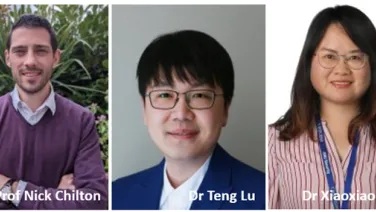
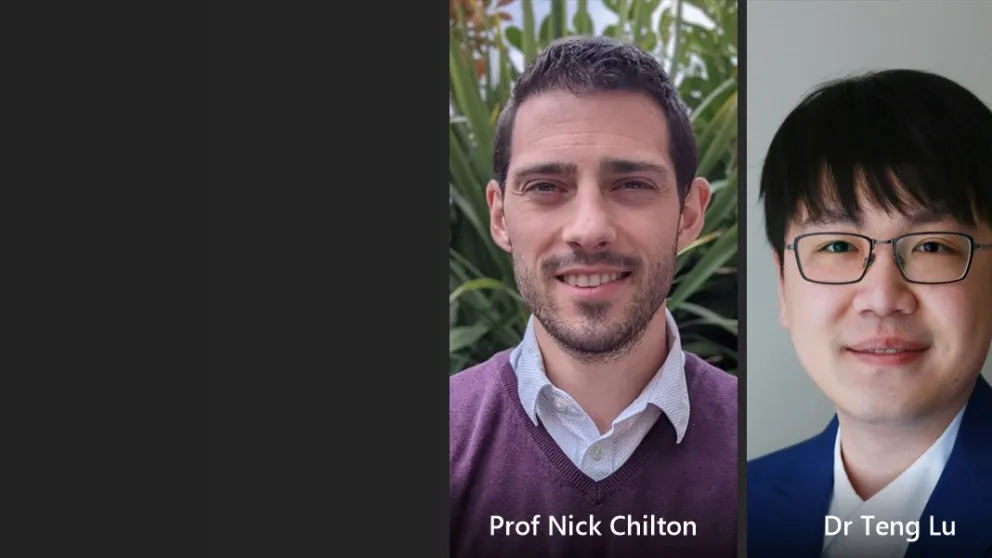
Professor Nicholas Chilton, Dr Teng Lu and Dr Xiaoxiao Zhang are among 20 ANU researchers awarded a total of $23.4 million in the latest round of ARC Future Fellowships.

Professor Christoph Nitsche has been awarded a five-year NHMRC Investigator Grant, the first ever received by the ANU Research School of Chemistry, to develop new protein and peptide therapies against infection and cancer.

A recent article in The Conversation by Brian Yates and Nathan Kilah explores why scientific thinking matters well beyond traditional science careers, using a career story based on RSC Director Professor Alison Rodger.

Could the invention of ‘molecular GPS’ help us develop better medicines?
Just like how GPS triangulates your location using satellites, scientists can now place labels at different positions around the surface of a protein…
3D-printed organs? It’s not as far-fetched as you think
These scientists can 3D-print living cells – a first step to printing our own organs.
Could a PhD in piezoelectric materials help spark your career?
The Australian National University is partnering with industry to help lead a new era in advanced materials science and provide opportunities for…No events are currently scheduled.