
Visiting Speaker - Prof. James Crowley
Heterometallic low-symmetry metallosupramolecular cages: Self-assembly, switching and molecular recognition
Speakers
Content navigation
Description

Heterometallic low-symmetry metallosupramolecular cages: Self-assembly, switching and molecular recognition
Self-assembled metallosupramolecular architectures (MSAs) or metal-organic cages (MOCs), depending on whom you ask, are the smaller, more soluble cousins of Metal Organic Frameworks (MOFs). Like their MOF cousins MSAs/MOCs can be exploited for the molecular recognition of a wide range of guests including reactive molecules, intermediates, pollutants and drugs.[1-4] For the most part MSAs/MOCs have tended to be high-symmetry and homometallic species. More recently there has been a drive to generate lower-symmetry and heterometallic MSAs/MOCs as part of efforts to further enhance the properties of these systems.[5] Some of the strategies we have developed for the synthesis of lower-symmetry heterometallic MSAs/MOCs featuring palladium(II) and platinum(II)/ruthenium(II) ions (Figure 1) will be described.[6-11] Additionally, the properties, including molecular recognition and switching, of the heterometallic MSAs/MOCs will be discussed.
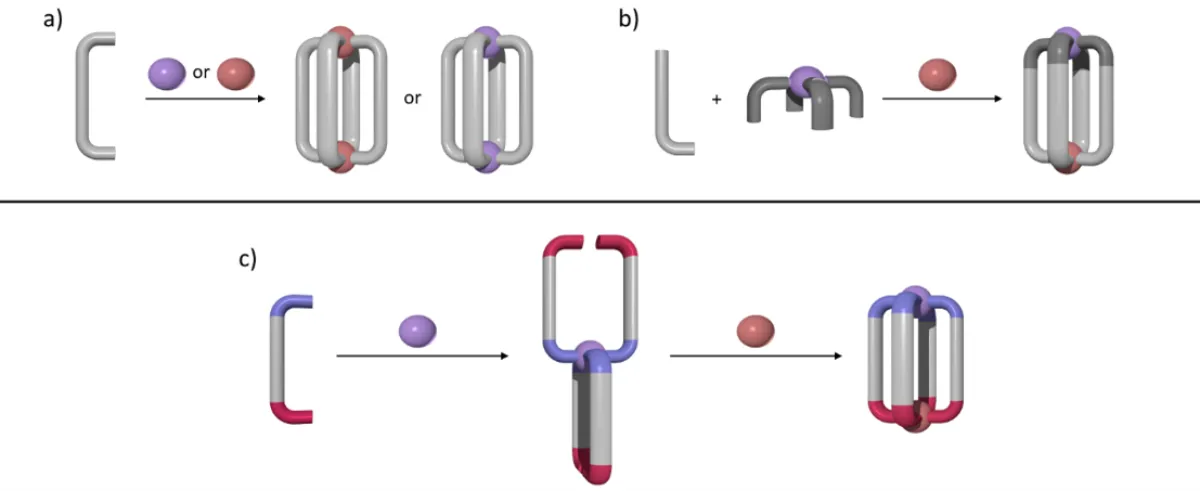
Figure 1: Cartoon representations of a) homometallic M2L4 cages systems (where M = Pd(II) or Pt(II)); b and c) related heterometallic PdPtL4 systems.
References
[1] T. R. Cook, P. J. Stang, Chem. Rev. 2015, 115, 7001-7045; [2] L. Catti, R. Sumida, M. Yoshizawa, Coord. Chem. Rev. 2022, 460, 214460; [3] L. Neukirch, G. H. Clever, Chem. Sci. 2025, 16, 12242-12276; [4] H. Takezawa, M. Fujita, Bull. Chem. Soc. Jpn. 2021, 94, 2351-2369; [5] L. K. Moree, L. A. V. Faulkner, J. D. Crowley, Chem. Soc. Rev. 2024, 53, 25-46; [6] H. B. Gearing, T. Sohnel, P. Young, L. Lisboa, L. J. Wright, J. D. Crowley, C. G. Hartinger, Chem. Commun. 2024, 60, 10950-10953; [7] H. B. Gearing, M. Cziferszky, T. Söhnel, L. J. Wright, J. D. Crowley, C. G. Hartinger, Chem. Sci. 2025, 16, 7294-7301; [8] A. C. Pearcy, L. S. Lisboa, D. Preston, N. B. Page, T. Lawrence, L. J. Wright, C. G. Hartinger, J. D. Crowley, Chem. Sci. 2023, 14, 8615–8623; [9] L. S. Lisboa, M. Riisom, H. J. Dunne, D. Preston, S. M. F. Jamieson, L. J. Wright, C. G. Hartinger, J. D. Crowley, Dalton Trans. 2022, 51, 18438-18445; [10] L. S. Lisboa, D. Preston, C. J. McAdam, L. J. Wright, C. G. Hartinger, J. D. Crowley, Angew Chem., Int. Ed. 2022, 61, e202201700; [11] L. S. Lisboa, J. A. Findlay, L. J. Wright, C. G. Hartinger, J. D. Crowley, Angew. Chem., Int. Ed. 2020, 59, 11101 –11107.
Biography
James Crowley obtained his BSc (Hons) (1998) and MSc (2000) from Victoria University of Wellington and completed his PhD (2000–2005) at the University of Chicago under the direction of Prof. Brice Bosnich. In 2005 he moved to Prof. David Leigh’s group at the University of Edinburgh, where he was awarded a British Ramsay Memorial Trust Fellowship (2006–2008), to carry out research on molecular machines and mechanically interlocked molecules. He started his independent career at the University of Otago in 2008 and has since moved through the ranks to Professor (2019). His major research interests are in catalysis, self-assembly, molecular recognition and the development of switchable systems. Thanks to the hard work of his co-workers and collaborators James has received several awards, including the New Zealand Institute of Chemistry Easterfield Medal (2013), Royal Australian Chemical Institute (RACI), Alan Sargeson Lectureship (2014), RACI Organometallic Chemistry Award (2015) and the 2017 Maurice Wilkins Centre Prize for excellence in Chemical Research (NZIC). Additionally, James was on the national council of the NZIC (2012-2019) and was the president of the institute in 2018.
Location
Building 138, Level 3, Seminar Room 3.105